
 This article is from Kk’onaat’oghee, kk’onaadedaale, tsooye (Birds, literally ‘things that fly’), a project of the TCC Migratory Bird Regional Co-Management Council and is a compilation of the Koyukon people’s rich history and personal stories that truly show the deep relationship with migratory birds that the Alaska Native people of the TCC region hold.
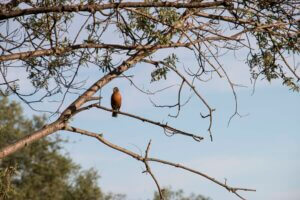
Fast Facts About Robins
- Denaakk’e: Delk’ehoo, delk’oohaa (U), kaałnoy (L), beł onh hooldloye
- Common: Robin red breast
- Scientific Names: Turdus migratorius
- Important Characteristics: Does much foraging on the ground, running, and pausing on open lawns; apparently locates earthworms by sight
- Habitat/Description: Lives in woodlands, suburban backyards, parks, and grasslands with shrubs. Robins can be found year-round in the continental United States, and some migrate north to spend summers in Alaska.
 Origin Story
Dotson’ Sa Ninin’ Atltseen, ‘Great Raven Who Shaped the World’. In this origin story, there was to be a great flood. Great raven arranged for pairs of all the animals, birds, and insects to board a raft. The seagull and robin were a big help in building the raft. After the flood, raven and seagull took off in opposite directions to look for land, to no avail. He asked the water animals to dive deep to look for land. Slowly, they brought back up mud, in which they made land and rivers. At first, he made the rivers flow in two directions, but that was too easy, so he changed it so they only flow in one direction. Then great raven created people, first out of rock, then clay so that they only live once. During the K’edon ts’ednee times, all of the animals were able to talk like people. Once he made people, the animals started being animals.
In the tenth story in the Ketetaalkkaanee series, Sooge, Marten, the traveler Betotoh comes upon a man who realizes he is following someone. Both the man and Betotoh go in circles as they continue to see the tracks left by Betotoh. The other man decides to snare him. Betotoh hears him talking away so he decides to play a trick on him by taking off his marten skin parka and stuffing it with rotten birch. Betotoh turns himself into a hawk owl and watches the man, laughing at the marten who has been fooled. The man, talking as if he were talking to many people, says he will roast the marten he caught. He makes a fire and sticks many skewers in the ground around the fire. He then goes to the spruce trees and creates a place to relieve himself. All set, he starts to cut into the marten, but only birch falls out. It is for this reason that when people tease each other’s, they say “Onts’aa k’etleedzode k’etltaanh.” ‘just like a hawk owl’. Today, the raven teases the hawk owl as it flies. The delk’ehoo, robin, teases it by flying towards it as if to hit it, then flies off again. The zʉhge, camp robber, does this as well. They do this because the k’etleedzode teased the marten man.
Robin Song
Dodo selenh “k’oolkkoy ts’eege’ teelzoot teelzoot.” sełnee, sełnee. Hee Hee! (Yukon River version)
Dodo selenh “k’oolkkoy ts’eege’ teelzuk teelzuk.” sełnee, sełnee. Hee Hee! (Koyukuk River version)
Dodo selenh “ch’oolkkoy ts’eeje’ teelzuch teelzuch.” sełnee, sełnee. Hee Hee! (Upper dialect version)
My brother-in-law downriver around the bend told me to slurp down the pike guts. Hee Hee!
Allakaket and Hughes version
Version by the late Lydia Simon, Huslia
Dodo selenh “k’oolkkoy ts’eege’, teelzook teelzook.” sełnee, sełnee. Hee! Hee!
Dodo selenh “k’oolkkoy ts’eege teelzuk, teelzuk, teelzuk.” sełnee, sełnee. Hee! Hee!
Translation:
- Dodo – down around the bend
- selenh – my brother-in-law (man speaking)
- k’oolkkoy, k’oolkkoy (U) – pike
- ts’eege’, ts’eeje’ (U) – guts, intestines
- teelzoot (YR), teelzuk (KR) – slurp (eat something like spaghetti without chewing, just sucking it into your mouth and down)
- sełnee – he tells me
Elder’s Stories
Late Alda Frank of Galena sang the song but said that the robin doesn’t sing it plainly now. She said her late father (Chief Henry of Huslia) used to say that the robin is changing its ways because it is learning the white people’s ways. He said the robin only sings parts of the song now. The late Benedict Jones stated that the robin isn’t singing its full song.