GENERAL ELECTION➡️ Tuesday, November 3rd
Voter Registration
Check your Voter Registration Status.
Find Your Polling Location
Find out where to vote based on you city and district.
Follow Us
Follow Interior Native Vote on Social Media.
What will be on my ballot?
Your ballot includes statewide candidates and ballot measures, along with legislative races and judicial retention questions that depend on where you live. Use this guide for a snapshot, and check your district’s sample ballot for the full list.
You can find out more at Alaska Division of Elections
- Jonathan S. ‘JKT’ Kreiss-Tomkins/ Zac Johnson (D/NP)
- Treg Taylor/ Candi English (R)
- Bernadette M. Wilson/ Michael K. Shower (R)
- Dave Bronson/Josh Church (R)
- Eric Hafner (D)
- Bill Hill (NP)
- James C. “Jim” McDermott (L)
- Nick Begich (R)
- Mary Peltola (D)
- Daniel J. Sullivan Jr.
- Dan S. Sullivan (R)
- Gerald L. Heikes (R)
This race varies depending on your House District.
Restore Political Party Primaries, End Ranked-Choice Voting, and Repeal Certain Campaign Finance Laws.
- A YES vote means: Replace open primaries with political party primaries and replace ranked-choice general elections with voting for one candidate per race. Repeal certain campaign contribution limits and disclosure rules adopted in 2020.
- A NO vote means: Keep open primaries, ranked-choice general elections, and the campaign finance rules this measure would repeal.
An Act Addressing Voter Qualification.
- A YES vote means: Change state law’s wording to specify that only U.S. citizens who meet the other voting requirements may vote. This would not change voter eligibility requirements.
- A NO vote means: Keep the current wording, which already requires U.S. citizenship and other qualifications to vote.
Voters decide whether judges should remain in office. Supreme Court retention appears statewide; Superior and District Court judges vary by judicial district.
- YES: Keep the judge in office.
- NO: Do not keep the judge in office.
You can review judge evaluations at ajc.alaska.gov.
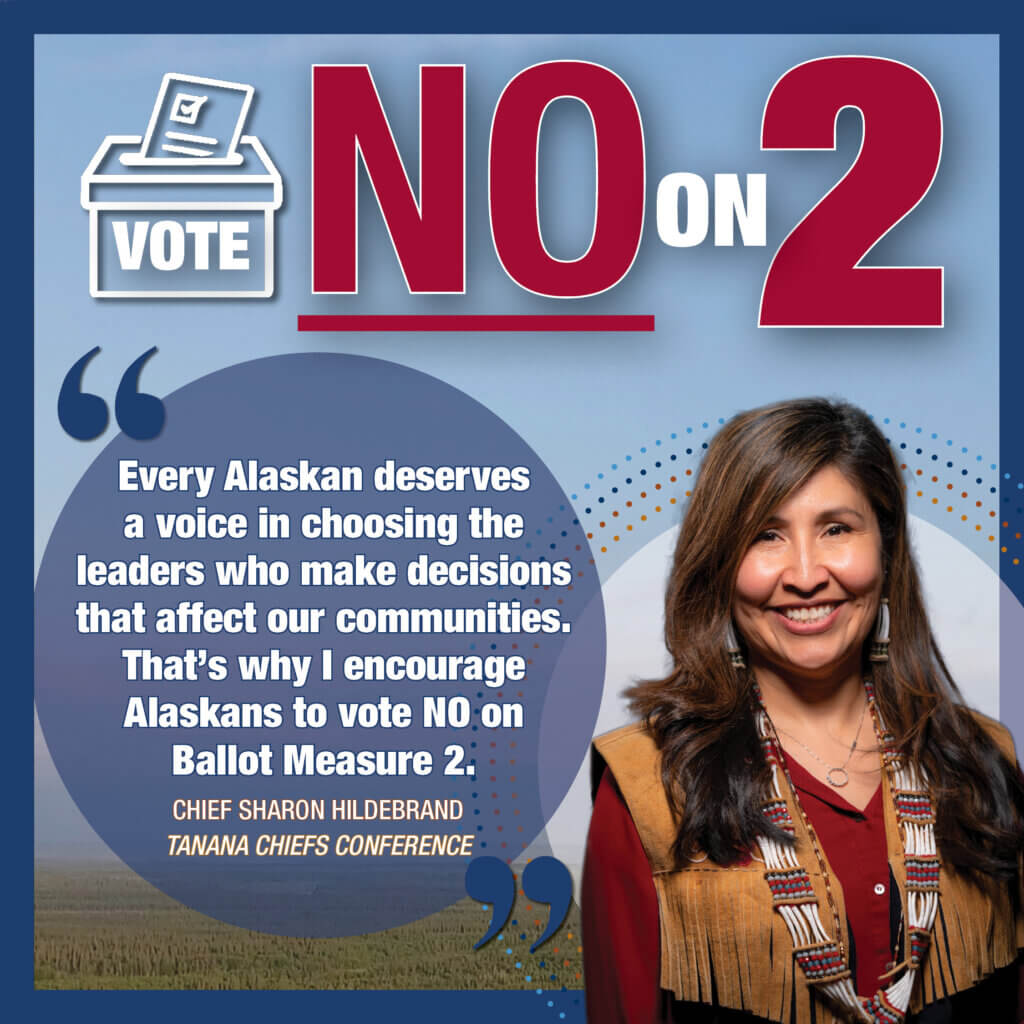
TCC is Encouraging a NO vote on Ballot Measure 2
Ballot Measure 2 would repeal Alaska’s open primary system, repeal ranked choice voting, and repeal campaign finance disclosure laws that require the true source of election spending to be disclosed. The TCC Executive Board believes these changes would reduce voter participation, limit voter choice, and decrease transparency in Alaska elections.
GET TO KNOW YOUR CANDIDATES
Select one of the options below to see how the candidates responded to questions important to our region.
For a full list of questions visit: ADN.COM
Governor/ Lt.Governor
See how they answer questions on Subsistence, Energy Costs and more.
U.S. Senate
See how they answered questions on Ambler Road, Ranked Choice Voting and more.
U.S. House
See how they answered questions about Tribal relationships, the Salmon Decline, and more.
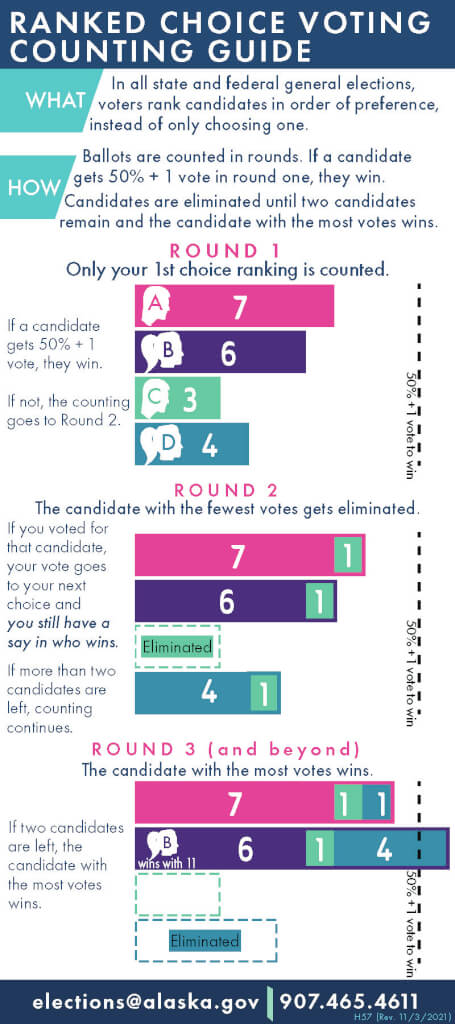
Ranked Choice Voting
Ranked Choice Voting allows voters to rank candidates in order of preference. In all state and federal elections, voters rank candidates in order of preference, instead of only choosing one.
- Rank the candidates you like in order of preference.
- Your favorite is your first choice.
- Ranking other candidates doesn’t affect your first choice.
- If a candidate receives a majority of first-choice votes (50%+1), they win. If no candidate receives a majority, the candidate with the fewest votes is eliminated and voters that ranked that candidate first have their vote counted for their next choice.
- This process continues until one candidate receives a majority of voters’ choices.
Learn more about ranked choice voting in the General Election here: Election Information – Division of Elections (alaska.gov)