
I grew up picking Alaska blueberries and learned from a young age to patiently and painstakingly pick about a gallon an hour on a good day. Compared to that, it’s incredibly satisfying to pick a gallon of saskatoons in 10 minutes.
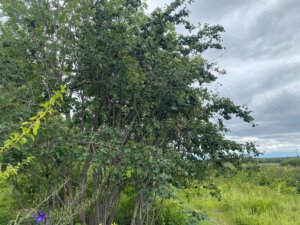
That’s what I love most about saskatoons — how large and prolific they are, and that they are a fruit and are easy to grow. That said, if you’ve been following my articles on berries (although technically saskatoons are a pome not a berry), I mentioned that I’m writing them in order of my personal preference. Saskatoons are downright near the bottom of the list.
I don’t want to denigrate them, because I like any/all local berries and fruit, but they are a bit fibrous and dry. Maybe what I also don’t like about them is that they remind me a bit of cultivated blueberries from the Lower 48. As an Alaskan, I turn my nose up at those store-bought blueberries in favor of Alaska blueberries.
Saskatoons (aka serviceberries or Juneberries) are a pome and are in the Rosacea family, same as apples. There are native saskatoons in Alaska (Amelanchier alnifolia Nutt.) The word saskatoon comes from the Cree word “misâskwatômina”. Saskatoon, Canada, is named for the berry, which grows in the region, and speaks to the importance of the berry as a food source for Indigenous peoples. Among other things, they were used in pemmican, which is an ideal use for them. I’ve made jam with the berries, and the jam is VERY firm, almost too firm to spread.
Martin and Smoky are the varieties recommended by the University of Alaska Fairbanks for Interior Alaska (www.uaf.edu/ces/publications/database/gardening/recommended-variety.php). They are grown at the Georgeson Botanical Garden in Fairbanks (https://www.uaf.edu/afes/places/gbg/). They’re incredibly prolific and have also reached heights where picking the berries requires a ladder. Many other varieties are available, but they have not necessarily been trialed in Alaska, or Interior Alaska specifically, and they vary in their cold hardiness. Here are some other descriptions of common Saskatoon varieties (gardening.usask.ca/gardening-advice/gardenline-nested-pages/food-plant-pages/fruit/saskatoon.php).
In addition to Martin and Smoky, Alaska Fruit Trees (sites.google.com/site/alaskafruittrees/home/saskatoons) also recommends Honeywood, Northline, Regent and Thiessen. Owners Steve and Sarah Masterman, have conducted extensive fruit and berry variety trials at their orchard.
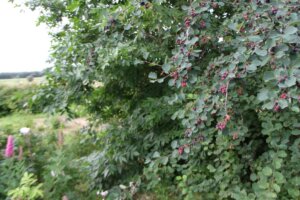
Saskatoons should be planted 3 to 5 feet apart and eventually form a hedgerow. They grow 3 to 26 feet high and 10 to 20 feet wide, depending on how they are pruned, according to the University of Saskatchewan (gardening.usask.ca/gardening-advice/gardenline-nested-pages/food-plant-pages/fruit/saskatoon.php#Saskatoons). The ideal pH is between 6 and 7, according to the University of Idaho (www.uidaho.edu/-/media/UIdaho-Responsive/Files/Extension/publications/bul/bul0866.pdf?la=en). They benefit from compost; fertilizer should be limited.
Ideally, you should prune them every year when the plant is dormant and keep the height from getting to the point where you need a ladder. You can also prune to let more light in by pruning branches from the base. Saskatoons may be productive for 30 to 50 years, so carefully choose your location. Old plants can be chopped down and allowed to re-grow.
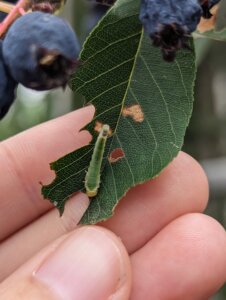
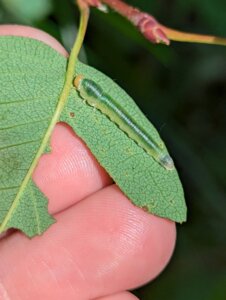
Alex Wenninger, entomologist with University of Alaska Fairbanks Cooperative Extension Service says the sawfly (Dineura militaris) is the most common pest she sees. Joey Slowik, a technician with UAF Extension Integrated Pest Management Program, notes birds, moose, and bears are a big issue. Bird netting can be used to protect the berries from birds or animals. Or you may find you have enough to share.
If they aren’t pruned correctly, powdery mildew can also be an issue. If you have questions about pests and diseases affecting your plants and how to reduce the damage, you can submit your questions to the Integrated Pest Management Program: plw.man.mybluehost.me/
You can find recipes and other information about Saskatoons here: www.uaf.edu/ces/publications/database/food/serviceberries.php I think this is one of the only jam recipes for berries that I’ve seen where you need to add water to the recipe.
The University of Saskatchewan (USask) offers a wealth of information on planting, growing, pruning, propagating, harvesting, cooking, preserving, and eating saskatoons, as well as information on the varietal characteristics: gardening.usask.ca/gardening-advice/gardenline-nested-pages/food-plant-pages/fruit/saskatoon.php#Saskatoons.
If you want an easy-to-grow shrub with edible berries that are highly productive, give saskatoons a try.
The annual Fairbanks Soil and Water Conservation District tree and shrub sale is May 22-23. You can find more information at trees.fairbankssoilwater.org/.
Questions about gardening or the Tribes Extension Program? Visit www.uaf.edu/ces/tribes Contact Heidi at hbrader@alaska.edu or (907) 474-6620. For more articles like this, go to: itgrowsinalaska.community.uaf.edu/
Heidi Rader is a professor of Extension and project director for the Alaska Tribes Extension Program. This work is supported by the Federally Recognized Tribes Extension Program Project 2022-41580-37957. It is a partnership with TCC. Any opinions, findings, conclusions, or recommendations expressed in this publication are those of the author(s) and do not necessarily reflect the view of the U.S. Department of Agriculture.