
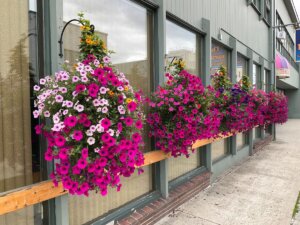
I often make a point to photograph the stunning hanging flower baskets around Fairbanks. A few years ago, I wrote an article about Festival of Fairbanks’ baskets and other standouts. In 2025, the baskets outside of Bahn Thai Restaurant stood out to me.
It took me a while to sleuth out where the baskets came from. After calling Bahn Thai a couple of times, I talked to Nonthapun Jaikunta, who has taken care of the baskets for the past three years. He told me Somnuk Wiggs, the owner of Bahn Thai, purchases the baskets from Lynn at the Farmers Market, which then led me to Lynn Mayo of Spinach Creek Farm.
It turns out, according to the Tanana Valley Farmers Market Manager Brad St. Pierre, Lynn and Spinach Creek Farm are not only famous for their carrots but also for their hanging baskets.
I asked Lynn to walk me through her process.
She said, “What I do is totally simple. I’m not quite as qualified as the greenhouses; I just put it all together.”

Here is her method:
Spinach Creek Farm has two greenhouses — one small and one large. The greenhouses are off-grid and so use no supplemental lighting. The flowers are started as early as mid-March depending on their variety on the heated cement slab of their smaller greenhouse. Wave petunias are started first. Lynn used to buy plugs, but they’ve become prohibitively expensive, so she starts all her flowers from seed.
Hanging Basket Recipe
- 2 Thunbergia (Black-eyed Susan vine)
- 2 Calibrachoa (Million Bells)
- 2 Bacopa, white
- 2-3 Shock Wave petunia (possibly one different color added)
- 2 Early Wave petunia
Each basket contains 6-8 total flowers, a combination of the above list, with each pair usually the same color. The Waves go in the middle, and the smaller plants go in each corner.
Plant in a 12-inch, square hanging basket from Western Pulp Products.
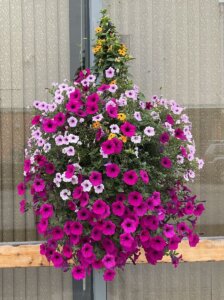
Lynn says the color scheme is a guess, but she hinted at a few color preferences. She said purple has been the most popular and dependable. One customer had issues with yellows attracting pests, and she stays away from reds. The baskets are all basically the same design, with different colors.
Lynn uses square, 12-inch hanging baskets from Western Pulp, made from recycled paper. She thinks this helps the baskets breathe and retain moisture. They use soil from Spinach Creek Farm with a bit of compost. She adds a bit of slow-release fertilizer.
Customers get a chance to choose their color schemes when the flowers are blooming and before the baskets are planted. After they start heating their larger greenhouse in mid-April, the baskets are hung above newly planted tomatoes to maximize the space. The hanging baskets are ready for customers to pick up in mid- to late May.
Once the customers pick up their baskets, it’s up to them to keep them looking beautiful all summer. Lynn recommends fertilizing weekly with soluble fertilizer and a quart or two of water a day. Her baskets prefer full sun.

Nonthapun Jaikunta is responsible for watering and fertilizing the baskets outside of Bahn Thai. Each morning, Nonthapun waters the baskets. Every other day, he fertilizes using 1½ tablespoons of soluble fertilizer (such as Miracle Grow) mixed with 176 ounces (or 22 cups) of water. He uses 22 ounces per basket (and waters without fertilizer every other day with about the same amount).
Lynn has been planting and selling hanging baskets for about 25 years. Although the Mayos sold them at the farmers market a few times, now they have regular customers and sell about 90 baskets a year for $65 each. Lynn recalled that some years, whole neighborhoods would request their hanging baskets. But, she said, what she does is really basic, and anyone could do it (although having a heated greenhouse helps).
But I think Lynn’s baskets combined with Nonthapun’s precise care makes for some uniquely stunning flowers, and I’m impressed by their quiet dedication to creating and maintaining something so beautiful each year.
Questions about gardening or the Tribes Extension Program? Visit www.uaf.edu/ces/tribes Contact Heidi at hbrader@alaska.edu or (907) 474-6620. For more articles like this, go to: itgrowsinalaska.community.uaf.edu/
Heidi Rader is professor of Extension in partnership with Tanana Chiefs Conference. This work is supported by the Federally Recognized Tribes Extension Program Project 2022-41580-37957. Any opinions, findings, conclusions, or recommendations expressed in this publication are those of the author(s) and do not necessarily reflect the view of the U.S. Department of Agriculture.
The University of Alaska (http://www.alaska.edu/alaska) is an equal opportunity/equal access employer and educational institution. The university is committed to a policy of nondiscrimination (http://www.alaska.edu/nondiscrimination) against individuals on the basis of any legally protected status.